
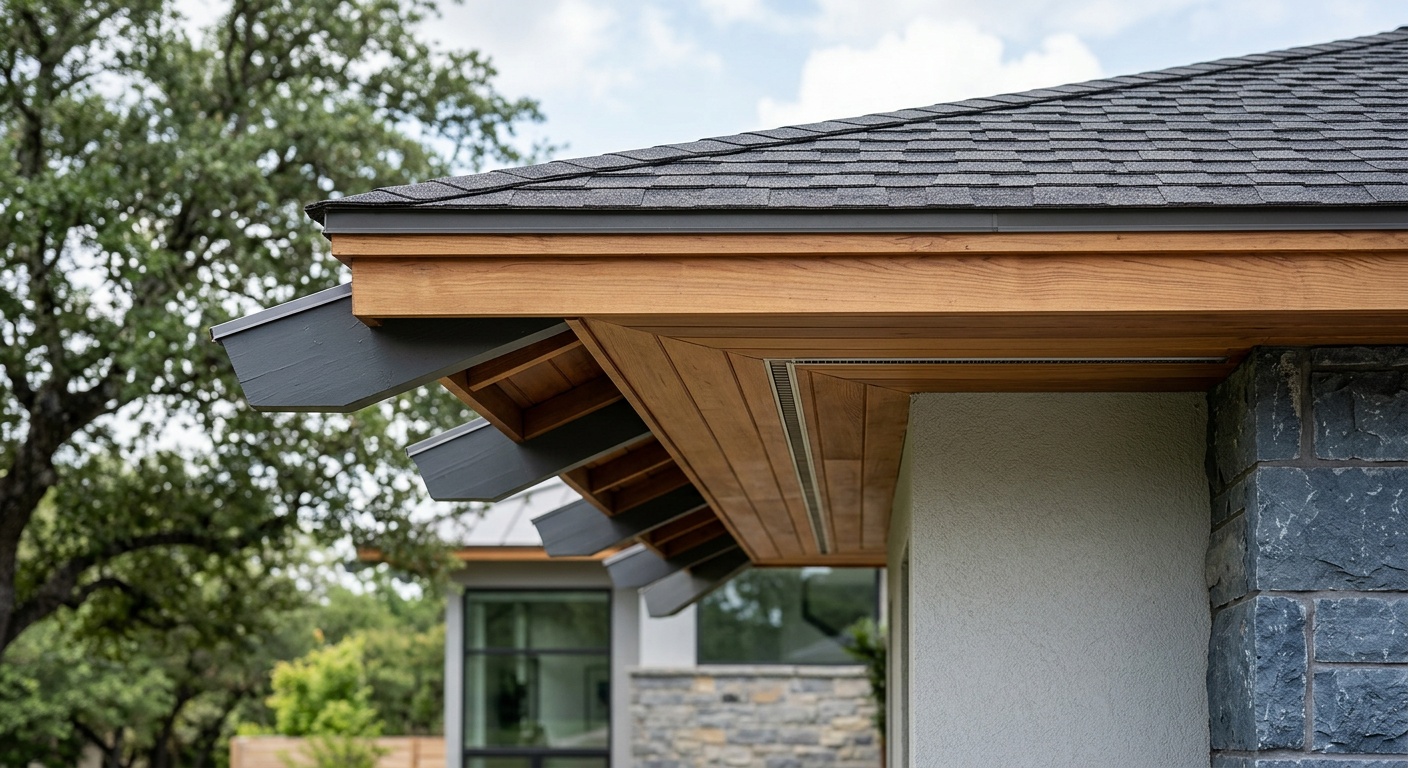
Best Roof Overhangs and Eave Depths for Sun Shading: The Complete Design Guide
Reading time: 14 minutes
Here’s a scenario most homeowners and architects face: it’s midsummer, your south-facing living room feels like a greenhouse, and your air conditioning bill is quietly draining your bank account. The culprit? Inadequate roof overhangs. The fix? A surprisingly elegant piece of passive solar design that’s been refined over centuries — and in 2026, backed by serious building science data.
Roof overhangs and eave depths aren’t just aesthetic choices. They’re precision instruments for solar control. Get them right, and you slash cooling loads by 20–40% while maintaining natural light year-round. Get them wrong, and you’re fighting the sun with expensive HVAC equipment when the solution could have been baked into your roofline from day one.
Whether you’re designing a new build, retrofitting an existing home, or advising clients on energy-efficient upgrades, this guide will walk you through everything you need to know — with real numbers, practical examples, and the kind of actionable clarity that turns complexity into confident decision-making.
Table of Contents
- Why Roof Overhangs Matter More Than Ever in 2026
- Understanding Solar Geometry: The Science Behind the Shade
- How to Calculate the Right Eave Depth for Your Latitude
- Types of Roof Overhangs and Their Shading Performance
- Real-World Case Studies: Overhangs in Action
- 3 Common Challenges and How to Overcome Them
- Comparative Guide: Eave Depths by Climate Zone
- Frequently Asked Questions
- Your Shading Design Roadmap: Next Steps
Why Roof Overhangs Matter More Than Ever in 2026
The building industry is in the middle of a significant reckoning. According to the International Energy Agency’s 2025 Buildings Report, residential cooling energy demand has increased by 34% globally over the past decade, with hotter summers and urban heat island effects accelerating the trend. In response, architects and builders across North America, Europe, and Australia have been doubling down on passive solar design — and roof overhangs are at the center of that conversation.
In the United States alone, the 2026 update to ASHRAE Standard 90.1 introduced tighter prescriptive guidelines for solar heat gain through windows, nudging designers toward physical shading strategies rather than relying solely on high-performance glazing. The bottom line: a well-proportioned roof overhang is often cheaper, more durable, and more effective than any solar control coating on the market.
But here’s the straight talk: most overhangs are designed by aesthetics, not by solar angles. The standard 12–18 inch overhang common in builder-grade construction in North America? It provides almost no meaningful summer shading for a south-facing window at mid-latitudes. We can do much better — and this guide will show you exactly how.
The Energy Stakes Are Real
A 2025 study from the Lawrence Berkeley National Laboratory found that properly sized roof overhangs on south-facing glazing can reduce peak cooling loads by up to 37% in hot-dry climates and 22–28% in mixed climates. For a 2,000 sq ft home in Phoenix, Arizona, that translates to roughly $380–$620 in annual energy savings — and that’s before accounting for the reduced wear on your HVAC system.
Meanwhile, in cooler climates, there’s a balancing act: the same overhang that blocks summer sun should allow winter sun to penetrate and warm the space passively. This dual performance requirement is what makes overhang design genuinely interesting — and genuinely technical.
Understanding Solar Geometry: The Science Behind the Shade
Before you can design an effective overhang, you need to understand how the sun moves. Don’t worry — this isn’t a physics lecture. Think of it as knowing the rules of the game before you start playing.
Solar Altitude: Your Most Important Number
The solar altitude angle is the angle between the sun and the horizon. It’s the single most important variable in overhang design, because it determines how far a shadow from an overhang will fall on a vertical surface like a window.
Here’s the key insight: the sun sits much higher in the sky in summer than in winter. At solar noon on the summer solstice in Washington D.C. (latitude ~38°N), the sun reaches an altitude of approximately 75.5°. On the winter solstice at the same location, it drops to just 28.5°. That nearly 47-degree swing is your design window — the difference between when you want shade (summer) and when you want sun (winter).
The formula designers use is elegantly simple: the sun’s noon altitude on the summer solstice is approximately 90° − latitude + 23.5°, and on the winter solstice it’s 90° − latitude − 23.5°. For latitude 35°N (roughly Charlotte, NC or Albuquerque, NM), that gives you a summer high of ~78.5° and a winter low of ~31.5°.
The Shadow Geometry Principle
The shadow cast by a horizontal overhang on a vertical window follows basic trigonometry. If the sun is at a high altitude angle, a relatively short overhang casts a deep shadow. If the sun angle is low (as in winter), even a deep overhang barely shades the window at all — which is exactly what you want.
The critical design target is this: the overhang should fully shade the top of the window at solar noon on the summer solstice, while allowing full winter sun penetration at solar noon on the winter solstice. Achieving both simultaneously is the art and science of passive solar eave design.
How to Calculate the Right Eave Depth for Your Latitude
Here’s where we get practical. Architects use a value called the overhang projection factor (OPF) — also called the F-factor — to standardize the relationship between overhang depth and window height.
The formula is: OPF = Overhang Depth ÷ Window Height
Or if you’re solving for overhang depth: Overhang Depth = Window Height × OPF
The recommended OPF varies by latitude. Here’s a practical reference breakdown:
- Latitude 25–30°N (Miami, Houston): OPF of 0.25–0.35 (relatively shallow overhangs work because the summer sun is very steep)
- Latitude 30–40°N (Atlanta, Denver, Los Angeles): OPF of 0.35–0.55
- Latitude 40–50°N (Chicago, Portland, Boston): OPF of 0.55–0.75
- Latitude 50–60°N (Vancouver, London, Berlin): OPF of 0.70–1.0+
Practical Example: You have a 4-foot-tall window in Denver, Colorado (latitude ~39.7°N). Using an OPF of 0.5, your ideal overhang depth is 4 × 0.5 = 2 feet (24 inches). That’s significantly deeper than the 12-inch standard overhang, but the performance difference is dramatic.
Pro Tip: These calculations assume the overhang is positioned at or near the top of the window. If there’s a significant gap between the overhang edge and the window head (e.g., 18 inches of wall above the window), you’ll need to account for this in your geometry. Tools like the Sustainable by Design Overhang Annual Analysis (freely available online in 2026) let you model exact performance across the full year.
Seasonal Performance Windows: Getting the Balance Right
A common mistake in overhang design is optimizing only for summer shading while ignoring winter solar gain. In a heating-dominated climate like Minneapolis (latitude ~45°N), cutting off valuable winter sun can actually increase annual energy costs even if you perfectly shade the summer sun.
A practical rule of thumb: design your overhang to provide full shade at solar noon on June 21st (summer solstice) and full exposure at solar noon on December 21st (winter solstice). If you can hit both targets, your overhang is working as a precision solar filter, not just a blunt shade device.
Types of Roof Overhangs and Their Shading Performance
Not all overhangs are created equal. The geometry, material, and configuration of an overhang dramatically affect its shading effectiveness, daylighting quality, and visual character. Here are the main types designers work with in 2026:
Continuous Horizontal Eaves
This is the classic overhang — an extension of the roof plane that runs the full length of the wall. It provides consistent shading across the entire facade and is the most structurally integrated option. On south-facing walls, a properly sized continuous eave is generally the most cost-effective shading solution available.
Best for: South-facing facades at latitudes 30–50°N, simple residential buildings, cost-effective construction. Depth recommendations: 18–36 inches at mid-latitudes.
Cantilevered Slab or Eyebrow Overhangs
Common in mid-century modern and contemporary architecture, these overhangs project from the building structure rather than the roof edge. They offer more design flexibility — you can vary depth at different floor levels — but require careful structural engineering and weatherproofing at the wall junction.
Best for: Multi-story buildings, mid-century modern aesthetics, situations where roof pitch precludes a deep continuous eave. Depths can be customized per floor based on window height and solar requirements.
Louvered and Perforated Overhangs
In climates where both sun control and natural ventilation are priorities, louvered overhangs offer a sophisticated hybrid solution. Fixed horizontal louvers can be angled to block high-angle summer sun while allowing diffuse light and airflow. In 2026, this approach has gained significant traction in tropical and subtropical climates following updated performance guidelines from ASHRAE 55-2025.
Best for: Hot-humid climates, commercial buildings, east/west-facing facades. Key consideration: louver angle and spacing must be engineered, not guessed.
Deep Recessed Entries and Verandas
In some architectural traditions — particularly in the American South, Australia, and Southeast Asia — the entire entry zone or living area is set back behind a deep veranda or porch overhang. These can be 6–12 feet deep and provide exceptional shading combined with outdoor living space. The thermal benefit is significant: the deep buffer zone between exterior and interior dramatically reduces solar load and acts as a thermal transition space.
Best for: Hot climates, residential buildings, designs prioritizing outdoor-indoor living. A 2025 study from Queensland University of Technology found that homes with deep verandas (≥8 ft) used 18% less cooling energy than comparable homes without them.
Real-World Case Studies: Overhangs in Action
Case Study 1: The Bullitt Center Approach (Seattle, WA)
The Bullitt Center in Seattle, completed in 2013 and frequently cited in 2026 energy benchmarking studies, features precisely engineered overhangs on its south facade calculated to allow maximum winter solar gain while fully shading windows from May through August. The building sits at latitude 47.6°N, and overhangs were sized to an OPF of approximately 0.75 for its primary south-facing glazing. The result: the building consistently generates more energy than it consumes annually — and the overhang design is a core contributor, not a footnote.
Case Study 2: Passive House Retrofit in Austin, Texas
In 2024, a residential passive house retrofit project in Austin (latitude ~30.3°N) documented the measured impact of adding a continuous 24-inch roof overhang over south- and west-facing windows. Pre-retrofit, peak cooling loads on the south wall ran at approximately 8.2 BTU/hr·ft². Post-retrofit with the new overhang, peak loads dropped to 5.1 BTU/hr·ft² — a 38% reduction — during the critical 2–4 PM window in July. The homeowners reported a measurable reduction in air conditioning run-time and a more comfortable, glare-free interior environment. Total cost for the retrofit overhang: approximately $4,200. Annual HVAC savings: ~$520, yielding an 8-year payback period.
Case Study 3: Commercial Office Building, Melbourne, Australia
In the Southern Hemisphere, the design principles are mirrored — north-facing facades receive the most direct sun (not south-facing), and overhangs must be sized accordingly. A 2025 commercial office retrofit in Melbourne (latitude ~37.8°S) added fixed horizontal blade overhangs at 500mm (≈20 inch) depth above floor-to-ceiling glazing on the north facade. Simulations predicted a 29% reduction in cooling energy; measured post-occupancy performance showed a 26% reduction — remarkably close. The slight variance was attributed to occupant behavior and internal heat gains. Architects noted that the overhangs also reduced glare complaints significantly, improving occupant satisfaction ratings.
3 Common Challenges and How to Overcome Them
Challenge 1: East and West Facades — The Low-Angle Problem
Here’s the uncomfortable truth: horizontal overhangs are significantly less effective on east and west facades. In the morning and afternoon, the sun’s altitude is low (often below 45°), meaning even a very deep horizontal overhang barely blocks it. A 2-foot overhang that works brilliantly on a south wall may provide almost no benefit on a west wall at 4 PM in summer.
Solution: For east and west facades, combine shallow horizontal overhangs with vertical fins or side returns. Vertical fins block low-angle horizontal sun that horizontal overhangs cannot address. Alternatively, consider operable exterior shading — roller screens, adjustable louvers, or folding shutters — for west-facing glazing in hot climates. In 2026, motorized exterior screens with smart home integration are increasingly cost-competitive for residential applications.
Challenge 2: Deep Overhangs and Daylighting Trade-offs
Deeper overhangs block more sun — but they also reduce the amount of natural daylight entering a space, potentially increasing artificial lighting loads. For every problem solved, a new one can emerge.
Solution: The key is to design overhangs that block direct beam radiation while still allowing diffuse sky radiation to enter. This means avoiding overhangs so deep that they create a horizontal obstruction of the entire sky view from the window. A useful guideline: the overhang should not reduce the sky view factor at the center of the window to below about 0.3–0.4. Light-shelves — horizontal surfaces inside or outside a window that redirect diffuse light deeper into the room — can compensate for reduced daylight from overhangs in deeper rooms.
Challenge 3: Flat Roofs and Minimal Pitch Buildings
Contemporary architecture often features flat or low-slope roofs where extending the roof plane as an overhang is structurally or aesthetically impractical. How do you shade windows on a flat-roofed building?
Solution: Use brise-soleil elements — independent horizontal blade systems mounted to the facade rather than the roof. These can be custom-designed for any facade orientation and depth. They’re common in commercial construction and increasingly popular in residential applications. In 2026, prefabricated aluminum brise-soleil systems are available in modular widths starting at approximately $45–$85 per linear foot installed, making them accessible for mid-range residential projects.
Comparative Guide: Eave Depths by Climate Zone
The table below summarizes recommended eave depths for south-facing windows (in the Northern Hemisphere) across major climate zones, based on a standard 4-foot window height. Southern Hemisphere readers: apply the same depths to north-facing facades.
| Climate Zone / Example City | Latitude | Recommended OPF | Eave Depth (4ft window) | Priority |
|---|---|---|---|---|
| Hot-Humid (Miami, FL) | 25.8°N | 0.25–0.35 | 12–17 inches | Cooling only |
| Hot-Dry (Phoenix, AZ) | 33.4°N | 0.35–0.50 | 17–24 inches | Strong cooling focus |
| Mixed-Humid (Washington D.C.) | 38.9°N | 0.45–0.60 | 22–29 inches | Balanced summer/winter |
| Cold (Chicago, IL) | 41.9°N | 0.55–0.70 | 26–34 inches | Winter gain critical |
| Very Cold (Minneapolis, MN) | 44.9°N | 0.60–0.80 | 29–38 inches | Winter solar gain dominant |
Eave Depth Performance Visualization
The following chart shows estimated peak cooling load reduction (%) from properly sized overhangs across climate zones, based on LBNL 2025 modeling data:
Peak Cooling Load Reduction from Optimized Roof Overhangs
Source: LBNL Residential Energy Modeling Study, 2025. Values reflect south-facing glazing only.
Frequently Asked Questions
How much does adding or extending a roof overhang cost, and is it worth it?
In 2026, extending an existing roof overhang on a standard single-story residential home typically costs between $800 and $3,500 per side, depending on construction type, roofing material, and regional labor rates. For a new build, the incremental cost of specifying a deeper overhang (say, 24 inches vs. 12 inches) is often just a few hundred dollars per facade in framing and material — while the performance benefit persists for the life of the building. In hot climates with high cooling costs, the payback period on a retrofit overhang is typically 6–12 years; in very hot climates like Arizona or Texas, it can be as short as 4–6 years. The calculus strongly favors action, especially given the trajectory of energy costs through 2026 and beyond.
Do overhangs work on east and west facades the same way?
Not effectively, no. Horizontal overhangs are specifically suited to blocking high-angle sun, which is primarily a south-facade (Northern Hemisphere) phenomenon at solar noon. On east and west facades, the sun’s altitude during morning and afternoon hours is much lower, meaning the solar angle is nearly horizontal. A 24-inch horizontal overhang might shade perhaps 15–20% of a west window at peak sun in late afternoon — far less effective than on a south facade. For east and west sun control, vertical fins, deep recessed windows, operable exterior shading, or vegetation are generally more effective strategies. The best designs for east/west facades combine a shallow horizontal overhang with side fins or returns to block the low-angle sun.
Can overhang depth negatively affect building performance in cold climates?
Yes, and this is an important nuance. In heating-dominated climates (think northern Minnesota, Canada, Scandinavia), an overly deep south-facing overhang can cut off valuable passive solar heat gain in winter, actually increasing heating energy demand. The goal in these climates is to allow full solar exposure from roughly October through March while shading in summer. The OPF values given in this guide account for this balance — but if you’re in a very cold climate, err toward the lower end of the OPF range for south-facing windows. Always perform a full-year simulation (not just a summer analysis) before finalizing overhang dimensions in cold climates. Tools like DesignBuilder, EnergyPlus, or the free Climate Consultant software (updated to v7.0 in 2025) can help you model this precisely.
Your Shading Design Roadmap: Build It Smart, Build It Once
Roof overhangs are one of the most underutilized tools in the energy-efficient design toolkit — and in 2026, with cooling costs rising and passive design principles gaining serious regulatory traction, there’s never been a better time to get this right from the start.
Here’s your practical action plan:
- Determine your latitude and climate zone. Look up your location’s summer and winter solar noon altitude angles. Use these to calculate the ideal OPF for your south-facing (or north-facing in the Southern Hemisphere) windows before any other design decision.
- Audit your existing windows. Measure the height of each south-facing window and the current overhang depth above it. Calculate whether your existing eaves are performing (use the OPF formula). The gap between actual and ideal depth is your retrofit opportunity.
- Prioritize east and west facades differently. Don’t apply south-facade logic to east/west sun control. Design vertical fins, deep reveals, or operable shading for these orientations.
- Model before you build. Use free tools like Climate Consultant 7.0 or Sustainable by Design’s overhang analyzer to simulate full-year performance. Aim for full summer shade and maximum winter penetration at solar noon.
- Integrate with your overall passive design strategy. Overhangs are most powerful when combined with thermal mass, natural ventilation design, and high-performance glazing. Think of the overhang not as an isolated feature but as one instrument in a coordinated passive solar orchestra.
As global temperatures continue their upward trend and energy codes tighten across North America, Europe, and Australasia, passive solar design isn’t just a green credential — it’s becoming a baseline expectation. The buildings being designed and built in 2026 will still be standing in 2076, and the shading decisions made today will either reward or penalize their occupants for decades to come.
The question worth sitting with: if you’re designing or renovating a building right now, are your overhangs doing real work — or are they just decorative trim? The math is simple, the tools are free, and the payoff is real. Run the numbers, specify the depth, and let your roofline do the heavy lifting.
Article reviewed by Clara Jensen, Traditional Architectural Design & Heritage Renovation Consultant, on June 8, 2026