
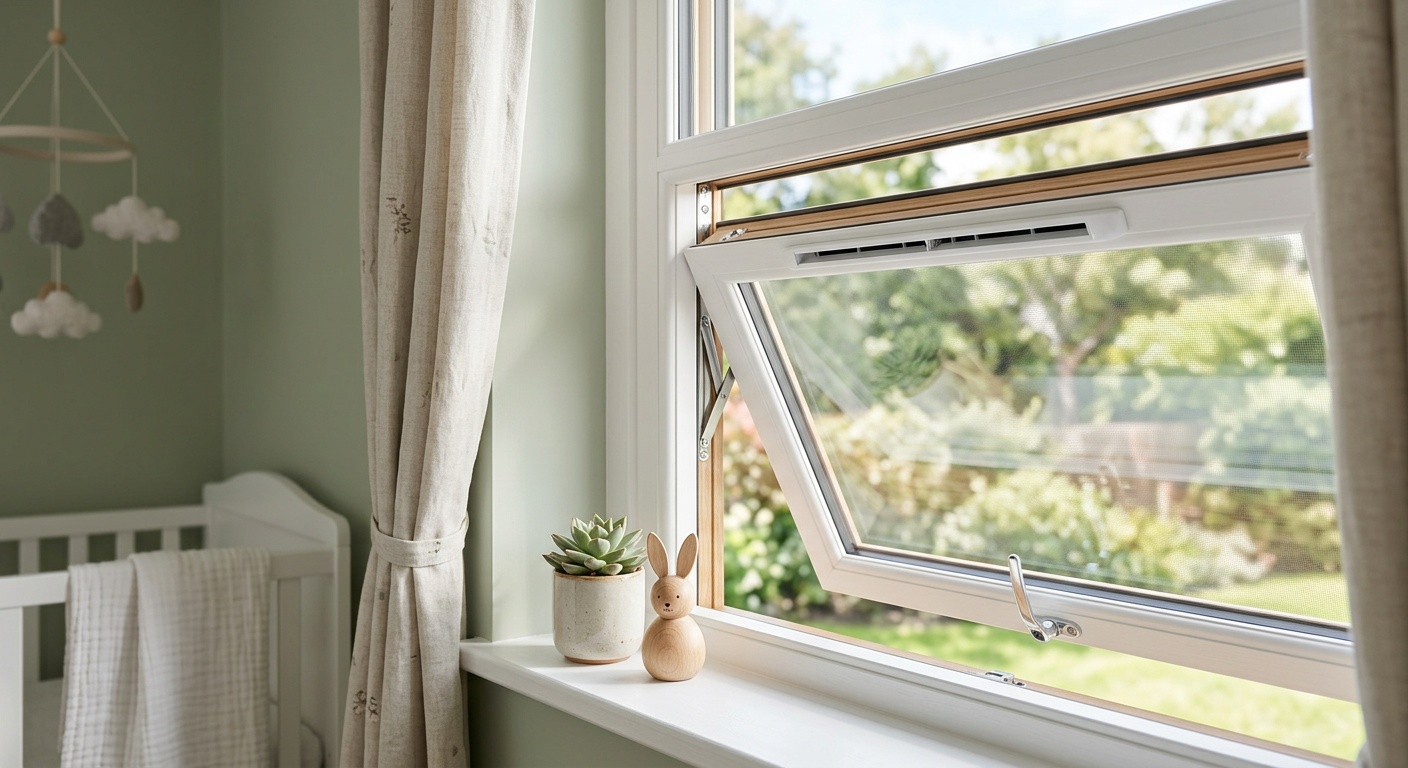
Designing a Nursery Room with Natural Ventilation and Thermal Comfort
Reading time: 12 minutes
Picture this: It’s 2 AM, your newborn is restless, and you’re wondering whether the room temperature is too warm, too cool, or just uncomfortable enough to be the culprit. Every new parent has been there. The nursery environment — specifically its air quality, temperature, and airflow — plays a more significant role in infant health and sleep quality than most parents realize when they’re busy choosing paint colors and crib mattresses.
Here’s the straight talk: getting your nursery’s thermal comfort right isn’t just about aesthetics or convenience — it’s a genuine health priority. According to the World Health Organization’s 2025 updated guidelines on infant sleeping environments, room temperature and air quality rank among the top three environmental factors influencing infant sleep quality and respiratory health. And the good news? You don’t need an expensive, energy-guzzling HVAC system to achieve this. Natural ventilation — the art and science of using passive airflow strategies to regulate indoor climates — offers a compelling, cost-effective, and healthier alternative.
This guide will walk you through everything from understanding the thermal needs of infants to practical design strategies you can implement whether you’re building new, renovating, or simply rearranging an existing nursery.
Table of Contents
- Why Thermal Comfort Matters for Infants
- Understanding Natural Ventilation Basics
- Designing for Airflow: Room Layout and Architecture
- Window Strategies That Actually Work
- Materials, Insulation, and Thermal Mass
- Cooling Solutions: Natural vs. Mechanical Options
- Common Challenges and How to Overcome Them
- Real-World Nursery Design Case Studies
- Comparative Guide: Ventilation Approaches
- FAQs
- Building the Perfect Environment: Your Next Steps
Why Thermal Comfort Matters for Infants
Newborns and infants are not miniature adults when it comes to thermoregulation. Their bodies are significantly less efficient at maintaining core temperature, making them highly vulnerable to both overheating and excessive cooling. The American Academy of Pediatrics (AAP) recommends maintaining nursery temperatures between 68°F and 72°F (20°C to 22°C) — a range that balances metabolic needs with safe sleep conditions.
Overheating in infants has been consistently linked to increased risk of Sudden Infant Death Syndrome (SIDS). A landmark 2024 study published in Pediatric Environmental Health found that nurseries with poor ventilation recorded ambient temperatures averaging 3–5°F higher than optimally designed rooms during summer months — a seemingly small difference with potentially serious consequences.
Beyond SIDS risk, thermal discomfort disrupts sleep architecture. Infants sleeping in overly warm rooms spend less time in restorative deep sleep, which impacts neurodevelopment. Conversely, rooms that are too cold trigger stress responses that increase cortisol levels — not ideal for a developing nervous system.
The Hidden Humidity Factor
Temperature is only half the story. Relative humidity in the nursery should ideally stay between 40% and 60%. Too dry, and nasal passages become irritated, increasing susceptibility to respiratory infections. Too humid, and you create conditions favorable for mold, dust mites, and bacterial growth — all potent triggers for asthma and allergies that can affect infants from their earliest weeks.
In 2025, the EPA updated its indoor air quality benchmarks for infant environments, specifically calling out humidity management as a “critical and often overlooked” parameter. Designing with natural ventilation helps regulate humidity organically, using outdoor air exchanges to maintain balance without mechanical intervention.
Understanding Natural Ventilation Basics
Natural ventilation works through two primary mechanisms: wind-driven ventilation and buoyancy-driven ventilation (also known as stack effect). Wind-driven ventilation uses pressure differences created by external wind to push air through openings — windows, vents, and gaps. Buoyancy-driven ventilation exploits the fact that warm air rises, drawing cooler air in through lower openings as warm air escapes through higher ones.
For a nursery, the most practical approach combines both mechanisms thoughtfully. A well-positioned window on the prevailing wind side combined with a high-level exhaust vent or operable skylight can generate consistent, gentle airflow without any mechanical assistance.
Cross-Ventilation: The Gold Standard for Nurseries
Cross-ventilation — where air enters through one side of a room and exits through another — is widely considered the most effective natural ventilation strategy for small rooms like nurseries. Studies from the ASHRAE 2025 Handbook show that cross-ventilated rooms achieve air change rates of 6–10 ACH (air changes per hour) under typical outdoor conditions, compared to 1–2 ACH in single-sided ventilated rooms.
To achieve true cross-ventilation in a nursery:
- Position inlet openings (windows, louvers) on the windward facade
- Position outlet openings on the leeward side or a perpendicular wall
- Keep furniture arrangements clear of air pathways
- Avoid placing the crib directly in the path of incoming airflow — indirect, diffused airflow is ideal
Designing for Airflow: Room Layout and Architecture
The physical design of a nursery has a profound impact on how effectively natural ventilation can function. Even the most cleverly positioned windows won’t help if the room’s internal layout blocks airflow.
Optimal Room Orientation
In the Northern Hemisphere, north-facing nurseries benefit from cooler, more consistent temperatures during summer but may need supplemental heating strategies in winter. South-facing rooms receive more solar gain — useful in colder climates but potentially problematic in warmer ones without proper shading. East-facing nurseries receive morning light and are generally cooler by afternoon, making them popular choices in warm climates.
The ideal orientation depends on your climate zone. For tropical and subtropical climates (increasingly relevant as climate patterns shift — 2026 data shows over 38% of the global population now lives in high heat-stress zones), a north or east-facing nursery with deep roof overhangs and high-level openings is preferable. For temperate climates, a south-facing room with adjustable shading systems offers the most flexibility.
Ceiling Height and Its Airflow Benefits
Higher ceilings dramatically improve natural ventilation performance. A standard 8-foot ceiling limits the stack effect; raising it to 9 or 10 feet creates meaningful buoyancy-driven airflow. If you’re renovating a nursery in an existing home, this may not be practical, but even adding a small ceiling fan at a low, gentle speed can simulate the effect of higher airflow volume without creating uncomfortable drafts.
Architects designing nurseries from scratch in 2026 increasingly incorporate clerestory windows — high, narrow windows near the ceiling line — to facilitate passive hot air exhaust while maintaining privacy and security at lower levels.
Window Strategies That Actually Work
Windows are the heart of any natural ventilation system, but their effectiveness depends entirely on type, placement, and operation strategy. Not all windows are created equal when it comes to nursery design.
Window Types Ranked for Natural Ventilation
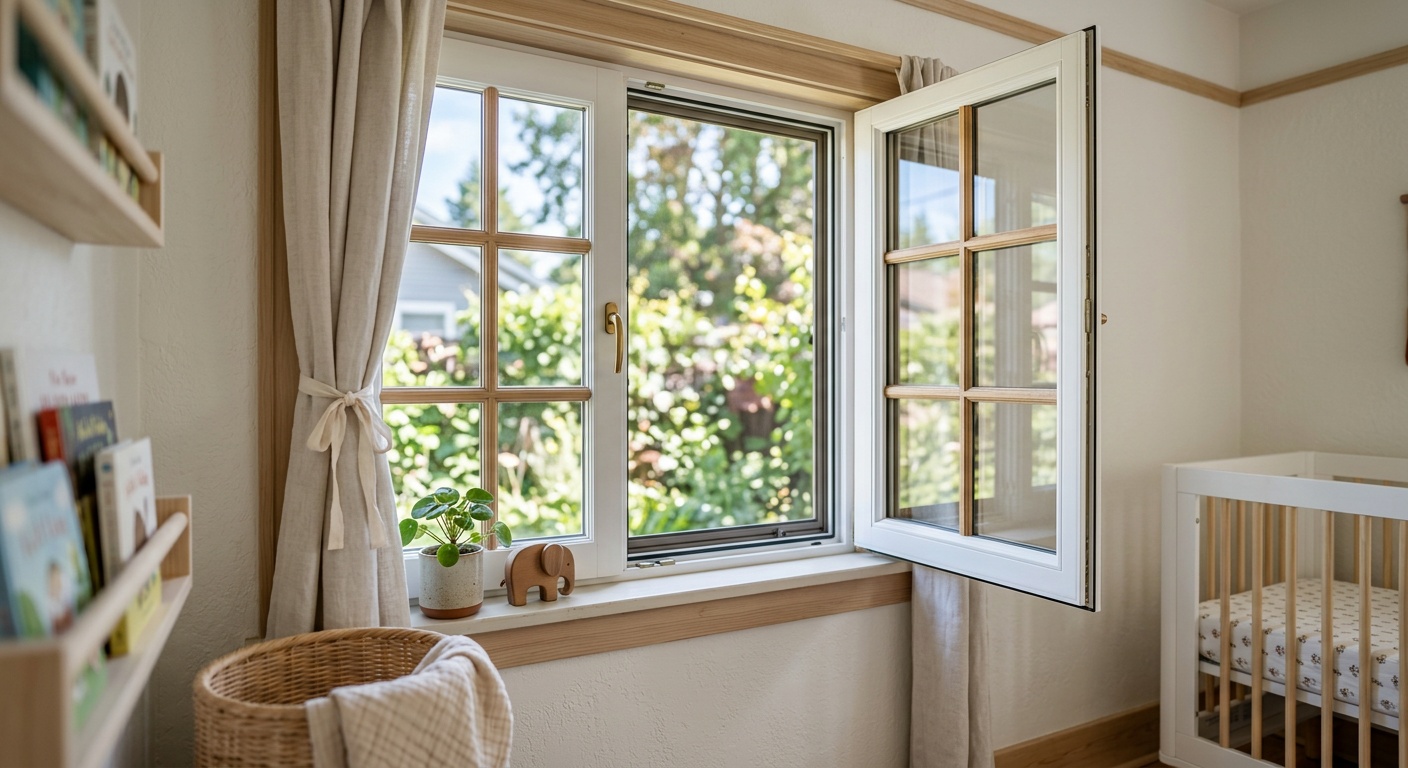
- Casement windows – Top performers; they open fully and can be angled to direct airflow precisely. Best for windward walls.
- Awning windows – Excellent for leeward walls; allow ventilation even during light rain.
- Hopper windows – Low-level hoppers draw in cooler floor-level air, ideal for summer cooling.
- Double-hung windows – Versatile; opening top sash exhausts warm air, opening bottom sash draws in cool air simultaneously.
- Sliding windows – Least effective; maximum opening is only 50% of the frame area.
For nurseries specifically, window safety is non-negotiable. All openable windows should have window guards or restrictors that allow ventilation while preventing falls. In 2026, many regions have updated building codes requiring maximum 4-inch openings for windows in rooms occupied by children under five — check your local regulations before finalizing window specifications.
Strategic Shading Without Blocking Airflow
One of the most common mistakes parents make is installing heavy, opaque window treatments that block solar heat gain — good — but also block ventilation — bad. The solution is exterior shading (overhangs, external shutters, or louvered screens) that blocks direct sunlight while allowing air movement, combined with lighter interior curtains for privacy. This approach can reduce solar heat gain by up to 70% without compromising airflow.
Materials, Insulation, and Thermal Mass
The materials you choose for nursery walls, floors, and ceilings have a significant impact on thermal comfort independent of ventilation. Thermal mass — the ability of a material to absorb, store, and release heat — is a key concept here.
High thermal mass materials like concrete, brick, or rammed earth absorb heat during the day and release it slowly at night, moderating temperature swings. This is particularly valuable in climates with large day-night temperature differentials. For nurseries in such climates, an exposed masonry feature wall or tiled floor (rather than carpet or vinyl) can meaningfully reduce peak afternoon temperatures.
Insulation, meanwhile, works differently — it slows heat transfer rather than storing it. A well-insulated nursery maintains its temperature more consistently regardless of outdoor conditions. Current best practice in 2026 recommends combining:
- High R-value wall and ceiling insulation (R-21 minimum for walls, R-49 for ceilings in most climate zones)
- Low-emissivity (low-E) double or triple-pane windows to reduce radiant heat transfer
- Thermal break details at window and door frames to eliminate cold bridges
Cooling Solutions: Natural vs. Mechanical Options
There will be days — particularly in the increasingly intense heat waves that characterized summers in 2025 across North America, Europe, and Asia — when natural ventilation alone isn’t sufficient. Understanding when and how to supplement with mechanical cooling is essential for responsible nursery design.
Many parents wonder whether mechanical cooling devices are safe for infants. If you’re evaluating your options, understanding is air cooler good for babies can help you make an informed comparison between evaporative coolers and traditional air conditioning units — both in terms of safety and effectiveness for infant environments.
The general hierarchy of cooling approaches for nurseries, from most to least preferable from a health and sustainability perspective:
- Passive natural ventilation – No energy cost, no noise, no mechanical components
- Ceiling fans or low-speed circulation fans – Minimal energy, gentle airflow
- Evaporative coolers (air coolers) – Energy-efficient, adds beneficial humidity in dry climates
- Split-system air conditioning with programmable thermostat – Most reliable temperature control but highest energy use
When mechanical cooling is used in a nursery, ensure the unit is positioned so that conditioned air doesn’t blow directly onto the sleeping area. Indirect airflow, directed toward the ceiling or a wall, creates gentle ambient cooling without drafts.
Common Challenges and How to Overcome Them
Let’s be practical. Even the best-designed nursery runs into real-world obstacles. Here are the three most common challenges parents and designers face, with concrete solutions.
Challenge 1: Urban Noise and Air Quality
Opening windows for ventilation in urban environments can introduce traffic noise and outdoor air pollution — a real dilemma for city-dwelling parents. The solution isn’t to keep windows permanently closed, but to ventilate strategically. Early morning hours (typically 5–8 AM) see the lowest urban pollution concentrations and traffic noise levels. Using this window (pun intended) for ventilation, combined with tight building envelopes for the rest of the day, captures fresh air when it’s cleanest.
Acoustic louvers — ventilation openings designed with sound-dampening baffles — are an increasingly popular 2026 solution for urban nurseries. They allow air exchange while reducing external noise by 15–25 decibels.
Challenge 2: Seasonal Extremes
A nursery that’s perfectly ventilated in spring becomes stuffy in August and drafty in December. The solution is a layered, adaptable approach: design the room for natural ventilation as the baseline, then add adjustable mechanical backup systems for seasonal extremes. Smart thermostats with infant-specific temperature alert functions (available from multiple manufacturers in 2026) can notify parents when room temperature strays outside the safe 68–72°F range.
Challenge 3: Security and Safety Concerns
Parents are understandably nervous about leaving windows open in a child’s room. The answer is purpose-designed ventilation hardware: window restrictors with key locks, security mesh screens with fly-screen functionality, and ventilation bricks or passive air vents built into the wall itself. Wall-mounted trickle vents, installed through the exterior wall, provide continuous low-level air exchange without any window needing to be open at all.
Real-World Nursery Design Case Studies
Case Study 1: A Passive House Nursery in Portland, Oregon (2025)
A young family retrofitting a 1960s bungalow in Portland worked with a certified passive house designer to create a nursery that maintained thermal comfort year-round with minimal mechanical intervention. Key strategies included adding 4 inches of external wall insulation, installing triple-pane casement windows on the east and west walls for cross-ventilation, and incorporating a heat recovery ventilator (HRV) that exchanged stale indoor air with fresh outdoor air while recovering 85% of the thermal energy. The result? The nursery maintained temperatures between 69–71°F throughout all four seasons with zero use of air conditioning and only occasional supplemental electric heating during the coldest weeks of winter.
Case Study 2: A Tropical Nursery in Singapore’s Tiong Bahru District (2026)
A designer working with a family in Singapore’s historic Tiong Bahru district faced the challenge of retrofitting a 1930s Art Deco apartment for a newborn. The original building, despite being 90 years old, had several natural ventilation advantages: high ceilings (10.5 feet), ventilation bricks above window openings, and good north-south cross-ventilation potential. The design team preserved and enhanced these features, adding external aluminum louvers for solar shading, installing a ceiling fan operating at its lowest setting for nighttime air circulation, and using high thermal mass floor tiles throughout. The family reported that the nursery remained comfortable at 22–24°C for more than 80% of the year without any air conditioning — remarkable for Singapore’s climate.
Comparative Guide: Ventilation Approaches
| Approach | Cost | Effectiveness | Noise Level | Best Climate |
|---|---|---|---|---|
| Cross-ventilation (windows) | Low | High (seasonal) | Silent | Temperate/Mild |
| Heat Recovery Ventilator (HRV) | Medium-High | Very High (year-round) | Low hum | Cold/Temperate |
| Ceiling Fan | Low | Moderate | Very low | All climates |
| Evaporative Cooler | Low-Medium | High (dry climates) | Moderate | Hot/Dry |
| Split-System Air Conditioning | High | Very High (all conditions) | Low-moderate | All climates |
Nursery Comfort Impact by Design Feature
Impact on Thermal Comfort (Relative Score out of 100)
FAQs
What is the ideal temperature range to maintain in a nursery for a newborn?
The American Academy of Pediatrics recommends keeping nursery temperatures between 68°F and 72°F (20°C to 22°C) for newborns. This range supports comfortable sleep while minimizing overheating risk, which is associated with increased SIDS risk. Use a reliable digital room thermometer placed at crib height — not wall height — for accurate readings of the temperature your baby actually experiences. In 2026, several smart nursery monitors combine temperature, humidity, and air quality sensors in a single device, sending alerts directly to parents’ smartphones when conditions drift outside safe parameters.
Can I use natural ventilation alone, or do I always need a mechanical backup?
In mild to temperate climates with moderate humidity, a well-designed natural ventilation system can maintain comfortable nursery conditions for the majority of the year without mechanical backup. However, having a mechanical option — even just a ceiling fan and a portable evaporative cooler — is prudent for extreme heat events, which are becoming more frequent globally. The key insight is that natural ventilation should be the primary strategy, not an afterthought, with mechanical systems serving as supplemental support rather than the default approach.
How do I ventilate the nursery safely when outdoor air quality is poor?
On high-pollution days — increasingly tracked via smartphone apps and municipal air quality networks — avoid opening windows during peak pollution hours (typically mid-morning and rush-hour periods). Instead, use trickle vents or mechanical ventilation units equipped with HEPA and activated carbon filters, which can remove particulate matter and volatile organic compounds from incoming air. If you use a window-based air purifier with a built-in filter, this allows some air exchange with filtration. Maintaining tight building envelopes when outdoor AQI exceeds 100 is advisable, supplemented by indoor air purifiers to maintain oxygen levels and remove indoor pollutants.
Building the Perfect Environment: Your Next Steps
You now have a comprehensive framework for designing a nursery that achieves genuine thermal comfort through intelligent passive design. The convergence of climate change, growing awareness of infant health science, and accessible design technology in 2026 means there’s never been a better time — or more urgent a need — to get this right.
Here’s your practical implementation roadmap:
- Audit your existing or planned nursery space. Identify which walls face prevailing winds and which receive the most solar exposure. This single step informs almost every other decision.
- Prioritize cross-ventilation in your layout. If you have any ability to influence window placement — even in a rental through portable solutions like window fans — position for diagonal airflow across the room.
- Address solar gain before thinking about cooling. External shading (overhangs, blinds, or awnings) prevents heat from entering in the first place, which is always more efficient than removing it once it’s inside.
- Install a reliable monitoring system. A quality temperature/humidity monitor at crib level gives you real data on how your strategies are performing — adjust based on evidence, not guesswork.
- Build in seasonal flexibility. Design your nursery’s ventilation approach for the shoulder seasons and have clear protocols for winter heating and summer supplemental cooling.
As urban heat islands intensify and extreme weather events become more routine, the principles of climate-responsive nursery design are evolving from nice-to-have to essential knowledge for every parent and designer. The investment you make in passive comfort now will pay dividends not just in infant health, but in energy savings and resilience for years to come.
The nursery you create isn’t just a room — it’s the first environment your child will know. What kind of relationship with the natural world do you want that space to model?
Article reviewed by Clara Jensen, Traditional Architectural Design & Heritage Renovation Consultant, on June 8, 2026