
Site Selection Checklist: What to Know Before Buying Land in Oklahoma
Reading time: 14 minutes
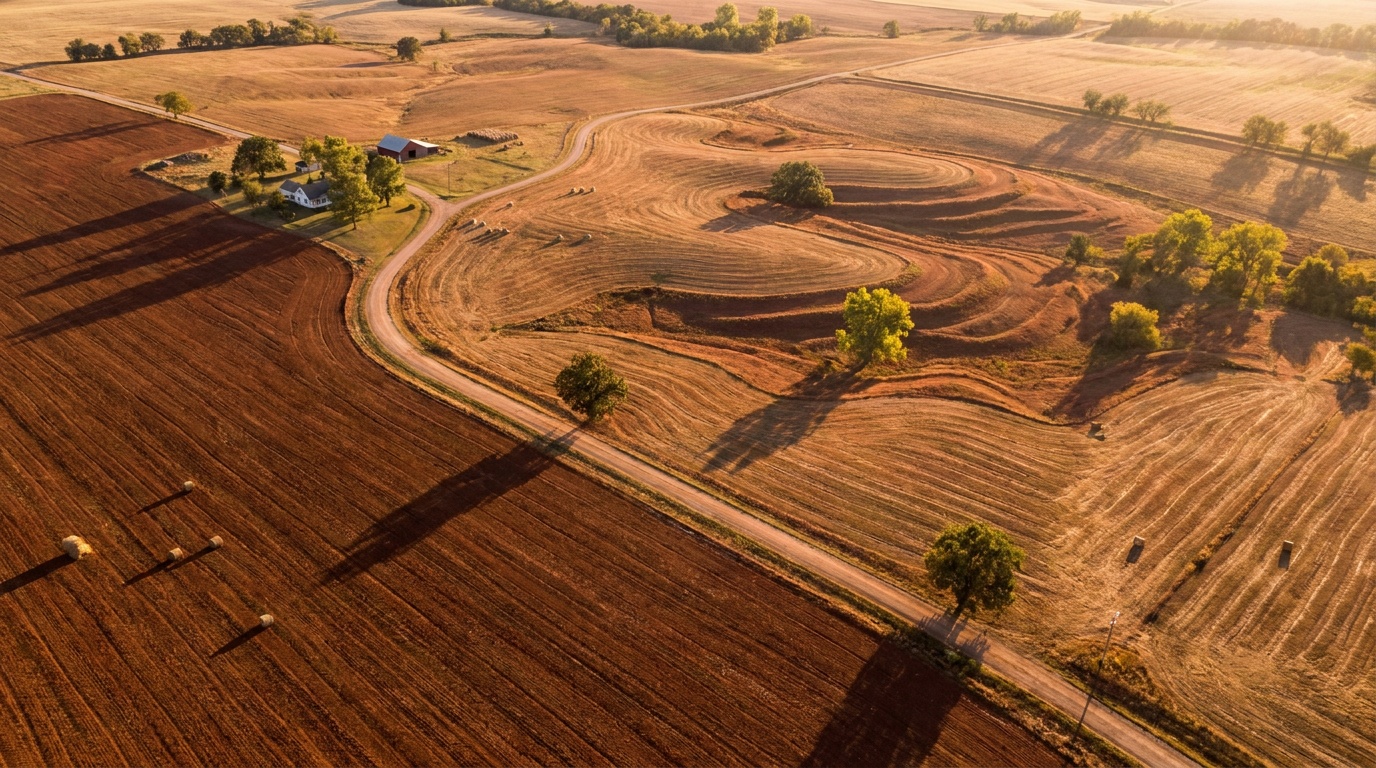
You’ve been eyeing that stretch of red dirt. Maybe it’s a rolling parcel near the Arbuckle Mountains, a flat agricultural tract in the Panhandle, or a suburban lot on the outskirts of Edmond. Whatever your vision — a homestead, a commercial investment, a rural retreat, or a development project — buying land in Oklahoma in 2026 is both an exciting and genuinely complex undertaking.
Here’s the straight talk: Oklahoma land is undervalued compared to neighboring Texas and Colorado, and savvy buyers are taking notice. But that opportunity comes with real risks — from hidden mineral rights disputes and flood zone complications to zoning restrictions and soil quality surprises. The difference between a smart investment and an expensive mistake? A thorough site selection process before you ever sign anything.
This checklist isn’t theoretical. It’s a practical, strategic guide built for real buyers navigating Oklahoma’s unique land market in 2026. Whether you’re a first-time rural buyer or an experienced investor expanding your portfolio, this guide turns complexity into your competitive advantage.
Table of Contents
- Why Oklahoma Land Demands Careful Due Diligence in 2026
- Zoning, Land Use, and Planning Restrictions
- The Mineral Rights Question: Oklahoma’s Defining Issue
- Water Access, Utilities, and Infrastructure
- Soil Quality, Topography, and Environmental Concerns
- Flood Risk and Natural Hazard Assessment
- Legal Title, Surveys, and Encumbrances
- Market Value, Comparables, and Investment Timing
- Oklahoma Region Comparison: Key Metrics
- Frequently Asked Questions
- Your Oklahoma Land Buying Roadmap: Next Steps
Why Oklahoma Land Demands Careful Due Diligence in 2026
Oklahoma’s land market has shifted meaningfully over the past two years. According to the USDA National Agricultural Statistics Service, the average value of Oklahoma cropland reached approximately $2,640 per acre in 2025, reflecting a 7% increase from 2024 — a trend that has continued into early 2026 as out-of-state investors and domestic buyers compete for premium agricultural parcels.
Simultaneously, rural residential land near growing metros like Oklahoma City, Tulsa, and Broken Arrow has appreciated sharply. The suburban sprawl effect — driven by remote work patterns that solidified post-2023 — has pushed demand for 5-to-40-acre lifestyle properties to levels not seen in over a decade.
But here’s what many buyers overlook: Oklahoma’s land ownership laws, mineral rights culture, and environmental quirks make it meaningfully different from buying land in most other states. The state’s complex oil and gas legacy means you could purchase surface rights while someone else owns what’s beneath your feet. Flash flooding risk is severe across much of the state. And rural areas often lack the utility infrastructure buyers assume is standard.
“Oklahoma land buyers who skip the due diligence phase often discover post-closing that they’re dealing with severed mineral estates, easements, or water challenges that fundamentally change the land’s usability. We see it regularly — and it’s almost always avoidable.” — A licensed Oklahoma real estate attorney practicing in Oklahoma County, 2025
The good news? With the right checklist, you can navigate every one of these issues confidently before committing a dollar.
Zoning, Land Use, and Planning Restrictions
Understanding Oklahoma’s Patchwork Zoning System
Oklahoma is one of the few states where unincorporated rural land frequently has no zoning at all. In many counties — particularly in the western two-thirds of the state — if a parcel lies outside city limits, you may have virtually unlimited freedom in how you use it. That can be liberating if you’re building an off-grid homestead or planning agricultural operations. But it’s a double-edged sword: your neighbors also face no restrictions, meaning an industrial operation or feedlot could emerge next door without any recourse.
Conversely, land within or adjacent to municipalities — even small towns — can be subject to strict zoning, setback requirements, and deed restrictions that limit your plans significantly.
Key Zoning Questions to Answer Before Purchase
- Is the parcel within city limits or in unincorporated county territory?
- If zoned, what is the current designation (agricultural, residential, commercial, industrial)?
- Are there Planned Unit Development (PUD) overlays or special use restrictions?
- Does the county have subdivision regulations that would affect dividing the parcel later?
- Are there deed covenants or homeowners association rules attached to the property?
- Is the land within a municipality’s extraterritorial jurisdiction (ETJ), which can affect future annexation?
Agricultural vs. Residential vs. Commercial Intent
Your intended land use should drive every question you ask. A buyer purchasing 80 acres for cattle ranching near Weatherford faces entirely different site selection criteria than someone buying a 2-acre lot outside Jenks for a custom home. Commercial buyers — say, someone scouting industrial land near the Tulsa Port of Catoosa — need to layer in transportation access, utility capacity, and environmental compliance considerations that residential buyers don’t face at the same scale.
Pro Tip: Always contact the county assessor’s office, the county planning department (if one exists), and the relevant municipality’s planning division before making an offer. In Oklahoma, many counties have made significant strides in 2025-2026 in digitizing their zoning maps, but discrepancies between online records and official documents still occur. Request written confirmation of zoning status.
The Mineral Rights Question: Oklahoma’s Defining Issue
If there is one topic that separates Oklahoma land transactions from nearly every other state, it’s mineral rights. Oklahoma’s oil and gas heritage — stretching back to the Spindletop era and the great gushers of the early 1900s — has created a landscape where severed mineral estates are extraordinarily common.
What “Severed” Mineral Rights Actually Means for Buyers
When mineral rights have been severed, the person who owns the surface of the land (you, after purchase) does not own the oil, gas, coal, or other subsurface minerals. A completely separate party owns those rights — and critically, mineral rights owners in Oklahoma have the legal right to access the surface to extract those minerals, with surface owners entitled to only “reasonable accommodation” and damage compensation.
This matters in very practical ways. An oil company holding mineral rights could legally enter your land, drill a well, and run pipelines across your property. Surface damage payments are governed by Oklahoma’s Surface Damage Act (70 O.S. § 318.2 et seq.), but the intrusion itself cannot be fully blocked if a valid lease is in place.
Real-World Scenario: The Murray County Homestead
Consider a 2024 case (representative of dozens that occur annually in Oklahoma): A family purchased 35 acres in Murray County near Sulphur for a weekend retreat and future homestead. The sale price seemed reasonable. Post-closing, they discovered that mineral rights had been severed three generations earlier and were held by a trust that had recently leased them to an independent operator. Within 18 months of purchase, a saltwater disposal well was permitted on a neighboring parcel with an easement crossing their property. The family had no legal mechanism to stop it. Their attorney later confirmed the issue would have been visible in a thorough title search — a step they had skipped to “save money.”
What to Do About Mineral Rights
- Run a complete title search going back at least 40 years — ideally further in oil-prone counties.
- Ask the seller directly: are mineral rights included? Get the answer in writing.
- Check the Oklahoma Corporation Commission’s well and permit records at oklahoma.gov/occ to identify existing production or permits near the parcel.
- If minerals are severed, evaluate whether any active leases exist and when they expire.
- In some cases, purchasing only surface rights is acceptable — but price it accordingly and factor in operational risk.
- Consult an Oklahoma oil and gas attorney, not just a general real estate attorney, for parcels in active producing areas.
Water Access, Utilities, and Infrastructure
Water is life — and in Oklahoma’s varied geography, water access is never guaranteed. From the water-rich eastern counties to the semi-arid Panhandle where the Ogallala Aquifer continues its documented decline, water availability and quality vary dramatically across the state.
Rural Water Districts vs. Private Wells
Roughly 60% of Oklahoma’s rural land parcels outside incorporated areas are served by one of the state’s Rural Water Districts — cooperatives established under Oklahoma Statutes that provide municipal-quality water service to rural customers. Being within a Rural Water District’s service area significantly increases a parcel’s livability and value.
Outside those service areas, buyers must rely on private wells. Before purchasing any rural parcel requiring a well, you should:
- Review the Oklahoma Water Resources Board (OWRB) well log database to assess depth-to-water in the area.
- Understand which aquifer would be accessed and its current recharge and depletion status.
- Budget $8,000–$22,000 for well drilling in 2026, depending on depth and geology — costs that have increased from 2024 levels due to equipment and labor inflation.
- Test existing well water for nitrates, arsenic, bacteria, and petroleum byproducts (common in oil country).
Electricity, Septic, and Internet Access
Electric cooperatives serve most of rural Oklahoma effectively, but always verify service availability before purchase. For septic systems, Oklahoma’s DEQ oversees individual on-site systems — a perc test (percolation test) on the specific parcel is essential, especially in clay-heavy soils common in western and central Oklahoma where drainage can be problematic.
Don’t overlook internet connectivity. In 2026, broadband access has become a critical land value driver. Oklahoma has deployed significant federal infrastructure funding under broadband expansion programs, with many rural counties receiving fiber upgrades through 2025-2026. Check the specific parcel’s connectivity status through Oklahoma’s broadband mapping portal — this can meaningfully affect both livability and future resale value.
Soil Quality, Topography, and Environmental Concerns
Oklahoma encompasses 10 distinct ecoregions, from the Cross Timbers to the Ozark Plateau to the High Plains. Soil type, slope, and environmental conditions vary enormously — and they directly affect what you can do with any given parcel.
Using USDA Web Soil Survey for Pre-Purchase Analysis
The USDA’s Web Soil Survey (websoilsurvey.sc.egov.usda.gov) is one of the most powerful free tools available to Oklahoma land buyers. It allows you to:
- Identify soil series and their suitability ratings for agricultural use, septic systems, buildings, and roads.
- Understand drainage class (well-drained vs. poorly drained) — critical in central Oklahoma’s heavy clay soils.
- Assess organic matter content and productivity indices for farming or grazing purposes.
- Identify shrink-swell potential, which is extremely high in Oklahoma’s expansive clay soils and can cause significant foundation damage for structures.
Environmental Red Flags Specific to Oklahoma
Oklahoma’s industrial history creates specific environmental due diligence requirements that buyers sometimes overlook:
- Brownfields and petroleum contamination: Parcels near former oil field operations, tank batteries, or pits may have soil and groundwater contamination. The Oklahoma DEQ maintains a database of known contaminated sites.
- Abandoned mines: Coal mining activity in eastern Oklahoma (Latimer, Le Flore, Coal counties) can leave subsurface voids that create sinkholes and structural risks.
- Agricultural chemical accumulation: Long-farmed parcels may carry herbicide or pesticide residuals — relevant if you’re planning organic production.
- Wetlands: Oklahoma has significant wetland acreage protected under federal Section 404 jurisdiction. Disturbing wetlands without Army Corps permits carries serious federal penalties.
Flood Risk and Natural Hazard Assessment
Oklahoma consistently ranks among the top five states nationally for flood damage costs. The combination of flat central plains, clay soils with low permeability, and intense convective storm systems makes flooding a serious, recurring risk across much of the state.
Before purchasing, check FEMA’s current Flood Insurance Rate Maps (FIRMs) — updated versions are available through the FEMA Map Service Center. Understand that many Oklahoma communities had FIRM updates in 2024-2025, meaning parcels previously considered low-risk may have been reclassified into Special Flood Hazard Areas (SFHAs), triggering mandatory flood insurance requirements for federally backed mortgages.
Beyond mapped flood zones, assess site-specific drainage characteristics. A parcel that sits at the low point of a natural drainage basin may flood regularly even without a formal FEMA designation. Walk the property after significant rain if possible, or speak to neighboring landowners about historical flooding patterns.
Oklahoma also faces tornado, hail, and severe wind risk that affects structures on the land. While this doesn’t directly change land value, it should influence building placement, design decisions, and insurance cost projections for any development plans.
Legal Title, Surveys, and Encumbrances
Title issues in Oklahoma are more common than in many states — a reflection of the state’s complex history of land runs, allotments, oil boom-era transactions, and generations of informal transfers. A thorough title examination by a licensed Oklahoma attorney (not just a title insurance company review) is strongly recommended for any significant purchase.
Critical Title and Survey Checklist Items
- Boundary survey: Never rely solely on the legal description in a deed without an updated survey. Fence lines in rural Oklahoma frequently do not match actual property boundaries.
- Easements: Pipeline easements, utility easements, access easements, and conservation easements may run with the land and limit your use significantly.
- Access rights: Is the parcel landlocked? Does it have legal (deeded) access to a public road? In rural Oklahoma, “accessed by county road” sometimes means a seasonal dirt track with no legal guarantee of maintenance or access.
- Liens and judgments: Outstanding property tax liens, mechanic’s liens, or judgment liens can cloud title.
- Tribal land considerations: Following the 2020 McGirt v. Oklahoma Supreme Court decision and subsequent rulings, land within the boundaries of Oklahoma’s Five Civilized Tribes’ historic territories involves complex jurisdictional questions. This affects roughly 43% of the eastern half of the state and has ongoing legal and regulatory implications in 2026 that warrant specific legal counsel.
Market Value, Comparables, and Investment Timing
Oklahoma land remains relatively affordable compared to national benchmarks, but “relatively affordable” doesn’t mean every parcel is fairly priced. Understanding how to evaluate market value in 2026’s specific conditions is essential.
How Oklahoma Land Values Vary by Region
Land values in Oklahoma span an enormous range. Trophy recreational land with deer, turkey, and water features in the Ouachita Mountain foothills of southeastern Oklahoma can command $3,500–$6,000 per acre. Meanwhile, dryland farming ground in Cimarron County in the Panhandle may trade at $400–$800 per acre. Prime irrigated cropland in the Arkansas River corridor near Muskogee regularly exceeds $3,000 per acre.
The key is understanding that Oklahoma land value is driven by a specific combination of factors: water access, soil productivity rating, proximity to growing metros, recreational attributes, mineral rights inclusion, and timber or energy potential. A parcel that’s “cheap per acre” may be appropriately priced — or significantly overpriced for its productive capacity.
Working With Accredited Land Consultants (ALCs)
For purchases above $150,000 — and certainly for agricultural tracts above 40 acres — working with an Accredited Land Consultant (ALC) designated through the REALTORS Land Institute provides measurable advantages. ALCs with Oklahoma specialization understand regional market nuances, have access to comparable sales data not available through standard MLS systems, and can help negotiate purchase price adjustments based on site-specific due diligence findings.
Oklahoma Region Comparison: Key Land Buying Metrics (2026)
| Region | Avg. Land Price/Acre | Mineral Rights Severance Risk | Flood Risk Level | Water Access Ease |
|---|---|---|---|---|
| Central Oklahoma (OKC Metro) | $1,800–$5,500 | High | Moderate–High | Good (Rural Water) |
| Eastern Oklahoma (Ozarks/Ouachitas) | $1,200–$6,000 | Moderate | High | Excellent (Surface Water) |
| Western Oklahoma (Farmland) | $800–$2,800 | Very High | Moderate | Variable (Well-Dependent) |
| Panhandle (High Plains) | $400–$1,200 | High | Low | Declining (Ogallala) |
| Tulsa Metro Suburbs | $3,000–$12,000+ | Moderate | Moderate | Good (Municipal/Rural Water) |
*Prices reflect 2026 market conditions. Range reflects variation based on soil quality, improvements, mineral rights inclusion, and specific location within region.
Due Diligence Priority Chart: Where to Focus Your Attention
Not all due diligence factors carry equal weight. Here’s a visual representation of the priority level buyers should assign to each major checklist area when purchasing Oklahoma land:
Mineral Rights Verification
Title Search & Survey
Water Access Confirmation
Flood Zone & Drainage
Zoning & Access Rights
Frequently Asked Questions
Can I build a home on any rural land I buy in Oklahoma?
Not automatically. While unincorporated rural land in many Oklahoma counties has no formal zoning, you may still face restrictions from deed covenants, floodplain regulations, DEQ septic requirements, and county subdivision rules. Always verify with the county assessor and health department before assuming you can build freely. If the parcel is within a Rural Water District that requires connection as a condition of service, that will also affect your building and utilities plan. Additionally, land within the McGirt jurisdictional areas of eastern Oklahoma may involve tribal building codes or permit requirements depending on the specific circumstances of the land and the buyer.
How do I find out if mineral rights have been severed from a property in Oklahoma?
The most reliable method is a professional title search conducted by an Oklahoma-licensed attorney or experienced land abstractor, reviewing the chain of title in the county courthouse records. You can also check the Oklahoma Corporation Commission’s public database at oklahoma.gov/occ for existing wells, permits, and leases associated with a parcel’s legal description. For a quick preliminary check, review the deed itself — if a previous conveyance excluded minerals from the transfer, that’s a clear indicator of severance. Never rely solely on a seller’s verbal assurance about mineral rights status. Title insurance typically does not protect buyers from known mineral rights issues disclosed in the public record.
Is Oklahoma land a good investment in 2026 compared to neighboring states?
For buyers who conduct proper due diligence, Oklahoma land continues to represent strong relative value in 2026. Land prices remain 30–50% below comparable Texas properties, and the state’s improving infrastructure, growing technology and aerospace employment base, and expanding recreational land market have created conditions for meaningful appreciation over the next 5–10 years. The Panhandle presents higher risk due to ongoing water depletion concerns. Eastern and central Oklahoma near metro growth corridors represent the most favorable risk-adjusted investment opportunities. That said, Oklahoma’s specific legal complexities — particularly around mineral rights and tribal jurisdiction — mean that professional guidance isn’t optional; it’s a core part of making any investment perform as expected.
Your Oklahoma Land Buying Roadmap: From Research to Closing
You’ve absorbed a lot — and that’s exactly the point. The buyers who succeed in Oklahoma’s land market aren’t the ones who move fastest. They’re the ones who build their checklist, work systematically, and treat professional expertise as an investment rather than an expense.
Here’s your concrete action roadmap:
- Define your land use clearly before you search. Agricultural, residential, recreational, commercial, or mixed? Your use case determines which checklist items are non-negotiable versus secondary. Write it down before you ever step on a parcel.
- Assemble your professional team early. An Oklahoma-licensed real estate attorney, an Accredited Land Consultant familiar with your target region, and a licensed surveyor should be identified before you make any offer. Their costs — typically $2,000–$8,000 total for standard transactions — are trivial against the purchase price and the risks they mitigate.
- Run the mineral rights and title check as your very first due diligence step. Don’t fall in love with a parcel before you know the mineral rights status. In Oklahoma, this check should precede everything else because it’s a potential deal-killer.
- Visit the property multiple times and in different weather conditions. A parcel that looks ideal in dry August looks very different after the spring storms that roll through central Oklahoma. Ground-truth the drainage, road access, and neighboring land uses personally.
- Negotiate based on findings. Every issue uncovered in due diligence is a negotiating point. Severed minerals, needed surveys, questionable access, required environmental remediation — all of these can and should be reflected in the final purchase price or in seller concessions.
Oklahoma’s land market in 2026 is dynamic, competitive in premium segments, and genuinely full of opportunity for informed buyers. As remote work continues to reshape where people live and invest, and as agriculture remains a cornerstone of the state’s economic identity, well-chosen Oklahoma land will hold and grow its value for decades.
The broader trend is clear: land as a tangible, finite asset class is attracting increasing interest from buyers who want both lifestyle benefits and investment resilience. Oklahoma sits at an interesting intersection of affordability and upside — but only for buyers willing to do the work this guide has outlined.
So ask yourself honestly: are you ready to buy Oklahoma land, or are you ready to invest in it? That distinction — between passive purchasing and strategic, informed acquisition — is exactly what separates land buyers who look back satisfied from those who look back with regret. Build your checklist. Do your homework. Then go find your piece of red dirt.
Article reviewed by Clara Jensen, Traditional Architectural Design & Heritage Renovation Consultant, on May 4, 2026